
TECHNOLOGY
TECHNOLOGY
Ensuring FEMA compliance by tracking and documenting the location and progress of debris removal crews, personnel, contractors, equipment and debris — IN REAL-TIME.
Electronic Debris Management SYSTEM
The DebrisTech Electronic Debris Management System is modeled after a proven debris monitoring method that utilized a combination of handwritten paper tickets, electronic databases, and a Geographic Information System (GIS). The DebrisTech system follows this same model but replaces handwritten tickets with real-time data collection devices. Paper receipts are still available but are no longer the primary record. DebrisTech handheld devices and software add a new level of documentation and security features. The built-in automated fraud detection and audit tools greatly reduce the potential for fraudulent activities that might result in costly de- obligations. The system can also provide real-time access to agencies, such as FEMA or the Inspector General, so that auditors can begin their task early, rather than months or years later.
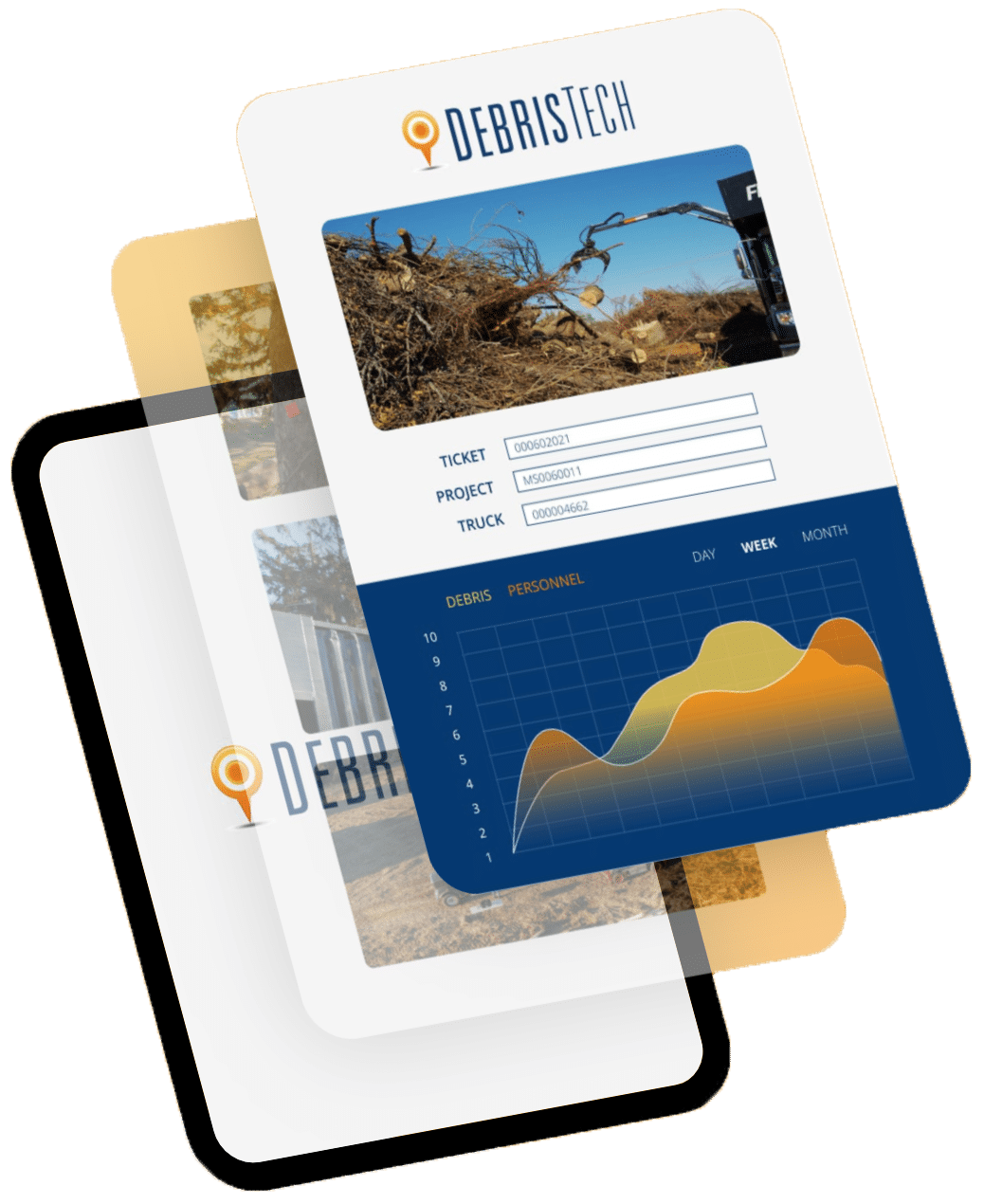
The DebrisTech Electronic Debris Management System provides real-time access to all aspects of debris removal operations through the DebrisTech Central Information Database. Data is fed to the Central Information Database in real-time by Debris Removal Monitors with DebrisTech devices. Authorized users have access to many different reports summarizing daily, weekly, or monthly activity by truck number, subcontractor, Right of Entry number, etc. This allows the debris management team to track the location and progress of debris removal crews, track the type and quantity of debris being collected, as well as fully document the loading and disposal locations, time, date, contractor, personnel, and equipment used. The real-time system eliminates the need for a large administrative staff to manually enter paper tickets. The DebrisTech System also has interactive mapping features that allow authorized users to view the exact pickup and disposal location for each debris ticket in real-time. Clicking on the load’s truck icon from the debris ticket list will show the pickup and disposal point for a specific load on a map. Clicking on the Truck icon in the header will show all loads in the current filter on a map. This feature is especially useful when trying to determine where a specific truck or subcontractor is working or has worked, or simply to see where debris removal operations are taking place in real-time. These are but a few of the extensive Geographical Information System (GIS) capabilities present in the system.
Since September 2012, DebrisTech has been utilized by more than 50 government entities in 20 different disasters and produced an unprecedented quality of documentation of the debris removal operations in these affected areas. DebrisTech is a field-proven system that will provide complete documentation of all debris removal activities. Specifically, DebrisTech was used in New York following Superstorm Sandy, Moore, Oklahoma following the devastating May 20, 2013 Tornados, and most recently, in Texas, Florida, Tennessee, Georgia, Louisiana, and Mississippi during the 2017 natural disaster season. DebrisTech’s work in Moore, OK has drawn a lot of attention from State and Federal stakeholders. There have been numerous occasions where both FEMA and USACE personnel working in the region have made special trips to Moore to see the system in operation. DebrisTech’s work in Moore, OK has also prompted FEMA to create a Best Practices video that highlights DebrisTech’s technology and processes that are being utilized in the recovery process.
In a typical deployment, DebrisTech sends one of its Mobile Command and Communications Centers to the project area. Each Mobile Command and Communications Center is a specially equipped, self-contained unit that provides office and living quarters for its key team members. Each unit has computers, printers, badging and placarding systems, communication systems, training systems, and an appropriate number of load and disposal site deployment kits. The load deployment kits typically contain 10 ruggedized tablets with MLPs, batteries, chargers, and ink cartridges, and a number of preprinted tickets. The disposal site kits typically include 4 tablets with MLPs, remote scanners, laser printers, paper, and printer cartridges. The kits are authorized for carry-on luggage and when necessary may travel ahead of the Mobile Command and Communications Center by airline.
Once deployment is initiated, a new server instance of the DebrisTech Debris Management Database System is created and replicated at two or more locations. In the case of this contract, we will bring our servers to the area in the event we can not rely on cellular internet connectivity to retrieve the data from our devices. All data is stored locally on the devices until a reliable internet connection is established, or until the end of the workday when the data can be retrieved by the local servers. We have equipment and procedures in place to periodically retrieve the data from the iPads throughout the day, even when cellular data service is not available. Once reliable cellular data service is restored to the area, we will resume our normal operations and real-time data will be available for viewing on our website to authorized users.
DebrisTech’s primary server location is served by a redundant primary fiber loop and its secondary and tertiary servers are geographically remote and served by different ISPs. Upon completion of a mission, a copy of all data collected is delivered to the Client in Microsoft Excel and PDF format. The data can also remain accessible through the DebrisTech Debris Management Database for any period as required by the contract.
Site Managers and Tower personnel are issued DebrisTech handheld scanning devices, loaded with custom software configured specifically for their role. DebrisTech handhelds have the ability to scan barcodes, take digital photographs, apply GPS location tagging, accept manual inputs in unrestricted fields, and communicate via the Internet using the cellular network and other means if required. When loading and disposal data is collected, it is wirelessly uploaded to the DebrisTech Central Information Database. If cellular service is not available, the data is queued on the device and transmitted when cellular network connectivity is obtained or alternatively when the devices are in range of the Mobile Command and Communications Center for download and transmission of the data via satellite communications.
Manual entry of data and the potential mistakes inherent are virtually eliminated with the DebrisTech process by using unique serialized debris ticket objects and an automated tracking system built around them. The DebrisTech truck certification process registers authorized debris hauling vehicles and equipment by electronically registering debris contractor trucks, trailers, and other hauling equipment. Digital images of each truck, trailer, or other hauling equipment are electronically linked to each individual registration/certification.
Each vehicle registration identifies the mission (contract number) and responsible governmental entity. Each registration record is permanently tied to the bar code that is affixed to the truck body or trailer body, supplying unique identification data for contractor vehicles and equipment. Standard forms of measure are utilized (e.g. feet and inches) to record the vehicle volume capacity utilizing industry-standard equations in each registration record created. Optionally, each driver of each truck may be issued a unique bar-coded DebrisTech ID that ties the driver to the load and/or haul vehicle. Each member of the certification team is issued a unique bar-coded ID that is scanned and becomes part of the certification registration form. The member certifying the vehicle must also sign the electronic form, using the signature capture feature. The DebrisTech System automatically rejects vehicles that are not certified and associated with the current event and responsible government entity. Vehicles that need recertification (obscured bar code placards, changes in sideboards, a spot check of capacities for random audits, etc.) can be compared electronically and automatically to the audit tables and other CQC audit records of previous certifications and registrations. Certification records are available online and in downloadable and printable forms for authorized users. Each monitor is also issued a unique identification badge that contains the employee identification barcode and Project ID barcode. Like the other barcodes, they are used to easily mark the ticket with the identity of the monitor or inspector that collects and/or reviews the data but they are not intended nor can they be used to circumvent the signature capture requirement. Each ticket has a barcode that is scanned using specially configured iPads. A limited number of these secure ticket objects are issued to monitors and inspectors. Without a physical ticket, no electronic tickets can be created. This is the first of a three-factor ticket authentication system. The uniquely configured iPad is the second factor. The apps used for collecting data are registered individually to unique serialized iPad IDs and will not function on unauthorized devices. These iPads in most cases are issued to individuals, but a third factor, a literal signature by the monitor or inspector is required at each data collection point through a built-in signature capture feature of the iPad. This factor reminds the submitter, that they are personally responsible for the accuracy of the data submitted.
Within 24 hours of notification, DebrisTech will provide an adequate number of professionals and qualified personnel to the project area to begin the startup of the Debris Removal Operation. DebrisTech will continue to increase its staffing from this point to meet the requirements of the local government’s contractor(s). Because we have worked constantly on various debris removal jobs since late 2015, we currently have a large staff of highly qualified individuals that are available to work on this project. DebrisTech is prepared to deploy as many resources as needed to meet the demands of this project.
DebrisTech will immediately establish a local office(s) that will be utilized for hiring, training, and coordination of operations between the contractor and the government. This office will be our base of operations for the duration of the project. DebrisTech understands the importance of utilizing local resources following a natural disaster. It is DebrisTech’s policy to hire as many local workers as are available in the project area to fill the field coordinator, load monitor, and tower monitor positions. Because we utilize Apple’s iPads for our load ticketing device, the training process is very efficient and normally takes less than 3 hours. This hiring and training process will begin as soon as our management team reaches the area and will continue until an adequate workforce has been established. We always work very closely with the Debris Removal Contractor to make certain that we have enough monitors available to meet their needs.
display:none
Your content goes here. Edit or remove this text inline or in the module Content settings. You can also style every aspect of this content in the module Design settings and even apply custom CSS to this text in the module Advanced settings.
TRACKING + REPORTING

- The DebrisTech Central Information Database provides access to all aspects of the debris removal process.
- Authorized users have access to many different reports summarizing daily, weekly, or monthly activity by truck number, subcontractor, Right of Entry Number, and much more.
- The Real-Time system eliminates the need for a large administrative staff to enter paper tickets manually.
HANDHELD SCANNERS

- The system replaces handwritten tickets with real-time data collection devices as the primary record.
- Each device is loaded with custom software configured specifically for each monitor’s role.
- All handheld devices have the ability to scan barcodes, take digital photographs, apply GPS location tagging, and accept manual inputs.
ON-SITE TRAINING

- The on-site training system includes an Apple TV that allows the employees to watch instructional videos & tutorials on the job site.
- Training is streamlined as DebrisTech’s First Responders are able to train large groups of locally hired monitors at any location in less than 2 hours.
- Technical Support Coordinators will be responsible for training device operators and truck certification personnel.
ID BADGE PRINTING

- With the field printing system, you have the ability to print custom id badges for all employees on site.
- A unique barcode can be assigned to any and all employees, allowing for faster, more efficient check-ins.
- Badges allow for easy employee identification and help track what team or contractor they work with.
BARCODE APPLICATOR

- Our custom-designed barcode application tool makes it simple to attach a barcode to each tree or stump surveyed.
- A digital photo, timestamp, tree/stump size, GPS coordinates, and inspector ID are all collected with each barcode.
- Unique truck/trailer barcodes are scanned at the loading and offloading points and provide additional valuable information.
REAL-TIME DATA.
REAL-TIME RECOVERY.
Electronic Debris Management Technology
- The DebrisTech Central Information Database provides access to all aspects of the debris removal process.
- Authorized users have access to many different reports summarizing daily, weekly, or monthly activity by truck number, subcontractor, Right of Entry Number, and much more.
- The Real-Time system eliminates the need for a large administrative staff to enter paper tickets manually.
- The system replaces handwritten tickets with real-time data collection devices as the primary record.
- Each device is loaded with custom software configured specifically for each monitor’s role.
- All handheld devices have the ability to scan barcodes, take digital photographs, apply GPS location tagging, and accept manual inputs.
- The on-site training system includes an Apple TV that allows the employees to watch instructional videos & tutorials on the job site.
- Training is streamlined as DebrisTech’s First Responders are able to train large groups of locally hired monitors at any location in less than 2 hours.
- Technical Support Coordinators will be responsible for training device operators and truck certification personnel.
- With the field printing system, you have the ability to print custom id badges for all employees on site.
- A unique barcode can be assigned to any and all employees, allowing for faster, more efficient check-ins.
- Badges allow for easy employee identification and help track what team or contractor they work with.
- Our custom-designed barcode application tool makes it simple to attach a barcode to each tree or stump surveyed.
- A digital photo, timestamp, tree/stump size, GPS coordinates, and inspector ID are all collected with each barcode.
- Unique truck/trailer barcodes are scanned at the loading and offloading points and provide additional valuable information.
display:none
Your content goes here. Edit or remove this text inline or in the module Content settings. You can also style every aspect of this content in the module Design settings and even apply custom CSS to this text in the module Advanced settings.
TECHNOLOGY
The DebrisTech Electronic Debris Management System is modeled after a proven debris monitoring method that utilized a combination of handwritten paper tickets, electronic databases, and a Geographic Information System (GIS). The DebrisTech system follows this same model but replaces handwritten tickets with real-time data collection devices. Paper receipts are still available but are no longer the primary record. DebrisTech handheld devices and software add a new level of documentation and security features. The built-in automated fraud detection and audit tools greatly reduce the potential for fraudulent activities that might result in costly de- obligations. The system can also provide real-time access to agencies, such as FEMA or the Inspector General, so that auditors can begin their task early, rather than months or years later.
The DebrisTech Electronic Debris Management System provides real-time access to all aspects of debris removal operations through the DebrisTech Central Information Database. Data is fed to the Central Information Database in real-time by Debris Removal Monitors with DebrisTech devices. Authorized users have access to many different reports summarizing daily, weekly, or monthly activity by truck number, subcontractor, Right of Entry number, etc. This allows the debris management team to track the location and progress of debris removal crews, track the type and quantity of debris being collected, as well as fully document the loading and disposal locations, time, date, contractor, personnel, and equipment used. The real-time system eliminates the need for a large administrative staff to manually enter paper tickets. The DebrisTech System also has interactive mapping features that allow authorized users to view the exact pickup and disposal location for each debris ticket in real-time. Clicking on the load’s truck icon from the debris ticket list will show the pickup and disposal point for a specific load on a map. Clicking on the Truck icon in the header will show all loads in the current filter on a map. This feature is especially useful when trying to determine where a specific truck or subcontractor is working or has worked, or simply to see where debris removal operations are taking place in real-time. These are but a few of the extensive Geographical Information System (GIS) capabilities present in the system.
Since September 2012, DebrisTech has been utilized by more than 50 government entities in 20 different disasters and produced an unprecedented quality of documentation of the debris removal operations in these affected areas. DebrisTech is a field-proven system that will provide complete documentation of all debris removal activities. Specifically, DebrisTech was used in New York following Superstorm Sandy, Moore, Oklahoma following the devastating May 20, 2013 Tornados, and most recently, in Texas, Florida, Tennessee, Georgia, Louisiana, and Mississippi during the 2017 natural disaster season. DebrisTech’s work in Moore, OK has drawn a lot of attention from State and Federal stakeholders. There have been numerous occasions where both FEMA and USACE personnel working in the region have made special trips to Moore to see the system in operation. DebrisTech’s work in Moore, OK has also prompted FEMA to create a Best Practices video that highlights DebrisTech’s technology and processes that are being utilized in the recovery process.
DEPLOYMENT
In a typical deployment, DebrisTech sends one of its Mobile Command and Communications Centers to the project area. Each Mobile Command and Communications Center is a specially equipped, self-contained unit that provides office and living quarters for its key team members. Each unit has computers, printers, badging and placarding systems, communication systems, training systems, and an appropriate number of load and disposal site deployment kits. The load deployment kits typically contain 10 ruggedized tablets with MLPs, batteries, chargers, and ink cartridges, and a number of preprinted tickets. The disposal site kits typically include 4 tablets with MLPs, remote scanners, laser printers, paper, and printer cartridges. The kits are authorized for carry-on luggage and when necessary may travel ahead of the Mobile Command and Communications Center by airline.
Once deployment is initiated, a new server instance of the DebrisTech Debris Management Database System is created and replicated at two or more locations. In the case of this contract, we will bring our servers to the area in the event we can not rely on cellular internet connectivity to retrieve the data from our devices. All data is stored locally on the devices until a reliable internet connection is established, or until the end of the workday when the data can be retrieved by the local servers. We have equipment and procedures in place to periodically retrieve the data from the iPads throughout the day, even when cellular data service is not available. Once reliable cellular data service is restored to the area, we will resume our normal operations and real-time data will be available for viewing on our website to authorized users.
DebrisTech’s primary server location is served by a redundant primary fiber loop and its secondary and tertiary servers are geographically remote and served by different ISPs. Upon completion of a mission, a copy of all data collected is delivered to the Client in Microsoft Excel and PDF format. The data can also remain accessible through the DebrisTech Debris Management Database for any period as required by the contract.
Site Managers and Tower personnel are issued DebrisTech handheld scanning devices, loaded with custom software configured specifically for their role. DebrisTech handhelds have the ability to scan barcodes, take digital photographs, apply GPS location tagging, accept manual inputs in unrestricted fields, and communicate via the Internet using the cellular network and other means if required. When loading and disposal data is collected, it is wirelessly uploaded to the DebrisTech Central Information Database. If cellular service is not available, the data is queued on the device and transmitted when cellular network connectivity is obtained or alternatively when the devices are in range of the Mobile Command and Communications Center for download and transmission of the data via satellite communications.
MONITORING METHODOLOGY
Manual entry of data and the potential mistakes inherent are virtually eliminated with the DebrisTech process by using unique serialized debris ticket objects and an automated tracking system built around them. The DebrisTech truck certification process registers authorized debris hauling vehicles and equipment by electronically registering debris contractor trucks, trailers, and other hauling equipment. Digital images of each truck, trailer, or other hauling equipment are electronically linked to each individual registration/certification.
Each vehicle registration identifies the mission (contract number) and responsible governmental entity. Each registration record is permanently tied to the bar code that is affixed to the truck body or trailer body, supplying unique identification data for contractor vehicles and equipment. Standard forms of measure are utilized (e.g. feet and inches) to record the vehicle volume capacity utilizing industry-standard equations in each registration record created. Optionally, each driver of each truck may be issued a unique bar-coded DebrisTech ID that ties the driver to the load and/or haul vehicle. Each member of the certification team is issued a unique bar-coded ID that is scanned and becomes part of the certification registration form. The member certifying the vehicle must also sign the electronic form, using the signature capture feature. The DebrisTech System automatically rejects vehicles that are not certified and associated with the current event and responsible government entity. Vehicles that need recertification (obscured bar code placards, changes in sideboards, a spot check of capacities for random audits, etc.) can be compared electronically and automatically to the audit tables and other CQC audit records of previous certifications and registrations. Certification records are available online and in downloadable and printable forms for authorized users. Each monitor is also issued a unique identification badge that contains the employee identification barcode and Project ID barcode. Like the other barcodes, they are used to easily mark the ticket with the identity of the monitor or inspector that collects and/or reviews the data but they are not intended nor can they be used to circumvent the signature capture requirement. Each ticket has a barcode that is scanned using specially configured iPads. A limited number of these secure ticket objects are issued to monitors and inspectors. Without a physical ticket, no electronic tickets can be created. This is the first of a three-factor ticket authentication system. The uniquely configured iPad is the second factor. The apps used for collecting data are registered individually to unique serialized iPad IDs and will not function on unauthorized devices. These iPads in most cases are issued to individuals, but a third factor, a literal signature by the monitor or inspector is required at each data collection point through a built-in signature capture feature of the iPad. This factor reminds the submitter, that they are personally responsible for the accuracy of the data submitted.
MOBILIZATION
Within 24 hours of notification, DebrisTech will provide an adequate number of professionals and qualified personnel to the project area to begin the startup of the Debris Removal Operation. DebrisTech will continue to increase its staffing from this point to meet the requirements of the local government’s contractor(s). Because we have worked constantly on various debris removal jobs since late 2015, we currently have a large staff of highly qualified individuals that are available to work on this project. DebrisTech is prepared to deploy as many resources as needed to meet the demands of this project.
DebrisTech will immediately establish a local office(s) that will be utilized for hiring, training, and coordination of operations between the contractor and the government. This office will be our base of operations for the duration of the project. DebrisTech understands the importance of utilizing local resources following a natural disaster. It is DebrisTech’s policy to hire as many local workers as are available in the project area to fill the field coordinator, load monitor, and tower monitor positions. Because we utilize Apple’s iPads for our load ticketing device, the training process is very efficient and normally takes less than 3 hours. This hiring and training process will begin as soon as our management team reaches the area and will continue until an adequate workforce has been established. We always work very closely with the Debris Removal Contractor to make certain that we have enough monitors available to meet their needs.